

Setting up an ESD-safe workstation requires a systematic approach to grounding, surface materials, and personnel protection. PK Elektronik Vertriebs GmbH provides specialized equipment for businesses to establish compliant environments. This guide outlines the essential components and logical steps for building a functional Electrostatic Discharge (ESD) protection area from the ground up.
Foundational Grounding and Flooring
Surface Materials and Workbench Configuration
The workbench surface is the primary point of contact for components. An ESD mat is a dissipative surface that allows static charges to flow slowly to ground. This slow discharge prevents sudden electrostatic discharges that can damage integrated circuits. When selecting a mat, consider the size of your work area and the type of components you handle. PK Elektronik provides a range of ESD mats and workbench accessories. Ensure that the mat is connected to a grounding point, typically via a wrist strap or a grounded table leg. The surface should be smooth and free of debris to prevent abrasion of components.
Personnel Grounding and Protective Equipment
Humans are a major source of static electricity. Personnel grounding is the process of connecting a worker to the earth ground to prevent static buildup. This is typically achieved using an ESD wrist strap. A wrist strap is a conductive band worn on the wrist that connects the worker to a grounded point. It must be worn at all times while handling sensitive components. In addition to wrist straps, consider ESD footwear and garments. These items help dissipate static charges from the body. PK Elektronik stocks a variety of ESD personal protective equipment (PPE) to ensure comprehensive coverage. Regular testing of wrist straps and footwear is essential to maintain their effectiveness.
Packaging and Component Handling
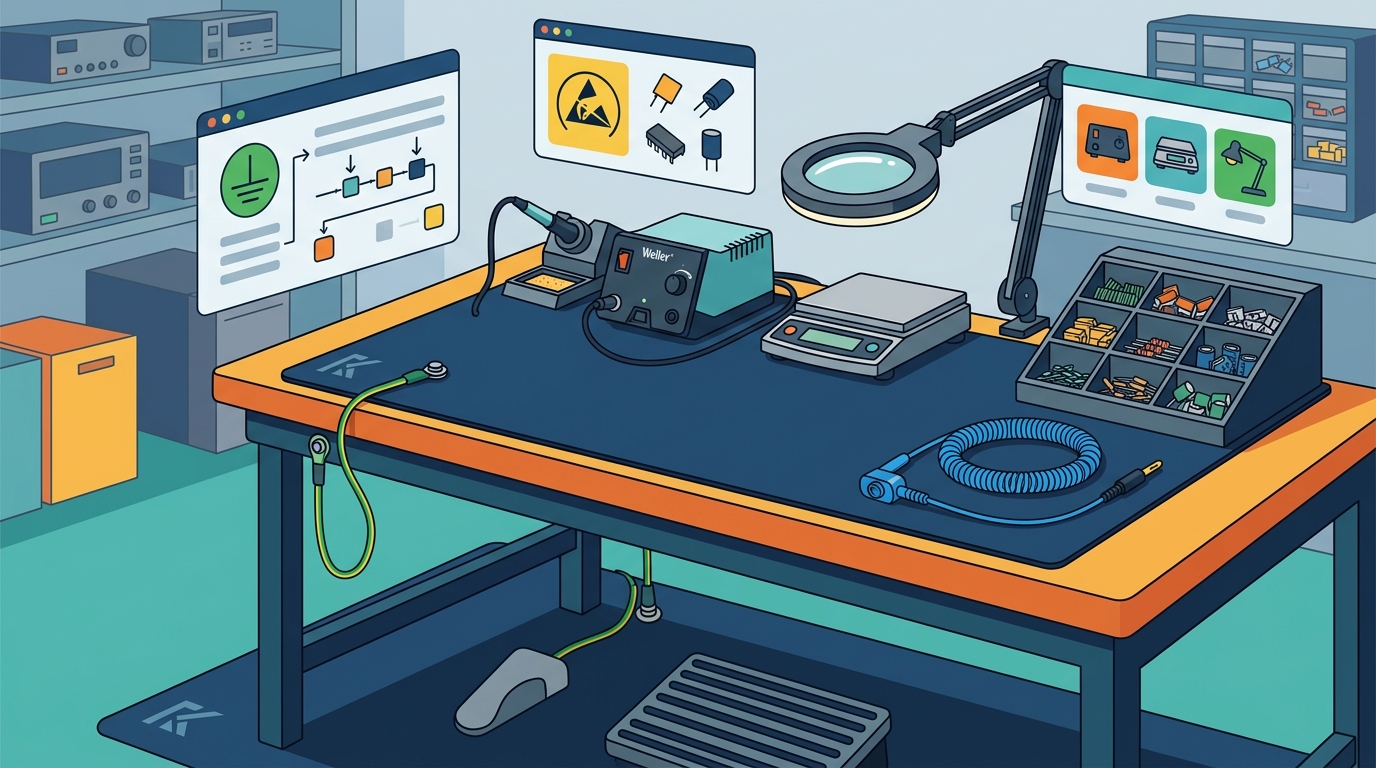
Monitoring and Compliance Verification
Key Takeaways
- ESD flooring is the foundation of a safe workstation and must be properly grounded.
- ESD mats provide a dissipative surface for handling sensitive components.
- Personnel grounding via wrist straps is essential to prevent static discharge from the human body.
- ESD-safe packaging protects components during storage and transport.
- Regular monitoring and testing ensure that all ESD equipment remains functional and compliant.
Frequently Asked Questions
What is the primary purpose of an ESD workstation?
The primary purpose is to protect sensitive electronic components from damage caused by electrostatic discharge.
How often should ESD equipment be tested?
Testing frequency depends on industry standards, but weekly or monthly checks are common for critical areas.
Can I use regular flooring for an ESD area?
No, regular flooring does not dissipate static charges and can lead to component damage.
What is the difference between conductive and dissipative materials?
Conductive materials allow charges to flow quickly, while dissipative materials allow charges to flow slowly.
Where can I buy ESD equipment in Germany?
PK Elektronik Vertriebs GmbH is a specialized supplier for businesses and public institutions in Germany.
Conclusion
Establishing an ESD-safe workstation is a critical step for any electronics manufacturing or repair facility. By focusing on grounding, surface materials, personnel protection, and monitoring, you can create a robust environment that safeguards your components. PK Elektronik Vertriebs GmbH is committed to supporting businesses with high-quality ESD equipment and expert advice. To explore our full range of ESD solutions, visit our online shop or contact us for personalized assistance. Learn more: Kontaktieren Sie uns.