

Workshop Lighting Guide: Selecting the Right Fixtures for Precision Tasks
Choosing the right workshop lighting requires balancing illuminance levels, color rendering, and environmental protection. PK Elektronik Vertriebs GmbH provides a comprehensive selection of professional lighting solutions for commercial users. This guide covers IP ratings, lux requirements, color temperature, and LED efficiency to help you optimize your workspace. For additional details, review the Kontaktieren Sie uns.
Understanding IP Ratings
Standard Workshop Environments
Wet or Dusty Areas
In areas with coolant mist, cleaning solvents, or heavy dust, higher ratings are necessary. An IP54 rating provides protection against dust ingress and splashing water from any direction. This is common for machine-mounted lights and robust workbench fixtures. For additional details, review the ESD Schutz L tstationen.
Lux and Lumens Requirements
Lumens measure the total amount of visible light emitted by a source. Lux measures the intensity of light falling on a specific surface area. Understanding the difference is critical for proper lighting design. You need to calculate the required lux for the task and select fixtures with sufficient lumens to achieve it. For additional details, review the Erem.
Calculating Required Light
The relationship between lumens and lux is defined by the area being illuminated. One lux equals one lumen per square meter. To determine the total lumens needed, multiply the required lux level by the area in square meters. This calculation helps in selecting the correct number of fixtures. For additional details, review the FLIR W rmebildkameras Infrarotkameras.
Color Temperature Selection
Color temperature is measured in Kelvin and describes the hue of the light. Lower Kelvin values appear warmer and yellower, while higher values appear cooler and bluer. The choice depends on the visual task and the desired atmosphere in the workshop. For additional details, review the PELI Schutzkoffer LED Taschenlampen.
Warm vs. Cool Light
Warm white light (2700K to 3000K) is comfortable for general viewing and breaks. Cool white light (4000K to 5000K) provides higher alertness and is preferred for detailed inspection tasks. Many professional workshops use 4000K as a standard balance between comfort and clarity.
Color Rendering Index (CRI)
Color Rendering Index (CRI) is a measure of how accurately a light source reveals the true colors of objects compared to natural light. A CRI of 100 represents perfect color rendering, such as sunlight. A lower CRI means colors may appear washed out or distorted.
Importance for Precision Work
For tasks involving color coding, such as wiring harnesses or PCB inspection, a high CRI is essential. A CRI of 80 or higher is generally recommended for professional environments. This ensures that technicians can distinguish between similar colors accurately, reducing the risk of errors.
LED Efficiency and Power
LED efficiency is expressed in lumens per watt (lm/W). It indicates how effectively a light source converts electrical power into visible light. Higher efficiency means lower energy consumption for the same light output. This is a key factor in reducing operational costs over the fixture's lifespan.
Comparing Technologies
Illuminance Levels by Task
Different tasks require different levels of illuminance to ensure safety and accuracy. General workshop areas may require lower levels, while precision assembly or inspection stations need higher intensity. Proper layering of light is key to a functional workspace.
| Task Type | Recommended Illuminance (Lux) | Notes |
|---|---|---|
| General Workshop / Aisles | 300 - 500 | Adequate for movement and general overview. |
| Assembly / Machining | 500 - 1000 | Standard for most production tasks. |
| Precision Inspection / Soldering | 1000 - 2000 | High detail work requires focused, bright light. |
| Quality Control / Color Matching | 1000 - 2000 | Requires high CRI in addition to high lux. |
Kelvin Scale Explained
The Kelvin scale is the standard unit for measuring color temperature in lighting. It ranges from warm to cool hues. Understanding this scale helps in creating a consistent visual environment across different workstations.
Common Kelvin Ranges
2700K to 3000K is considered warm white. 3500K to 4000K is neutral white. 5000K to 6500K is cool white. For most industrial applications, 4000K is the most versatile choice, providing clarity without causing eye strain over long periods.
Selecting LED Fixtures
Fixture selection involves matching the light source to the specific task and mounting location. Different fixture types serve different purposes in a workshop. Choosing the right form factor ensures the light is positioned correctly for the user.
Task Lighting vs. Ambient Lighting
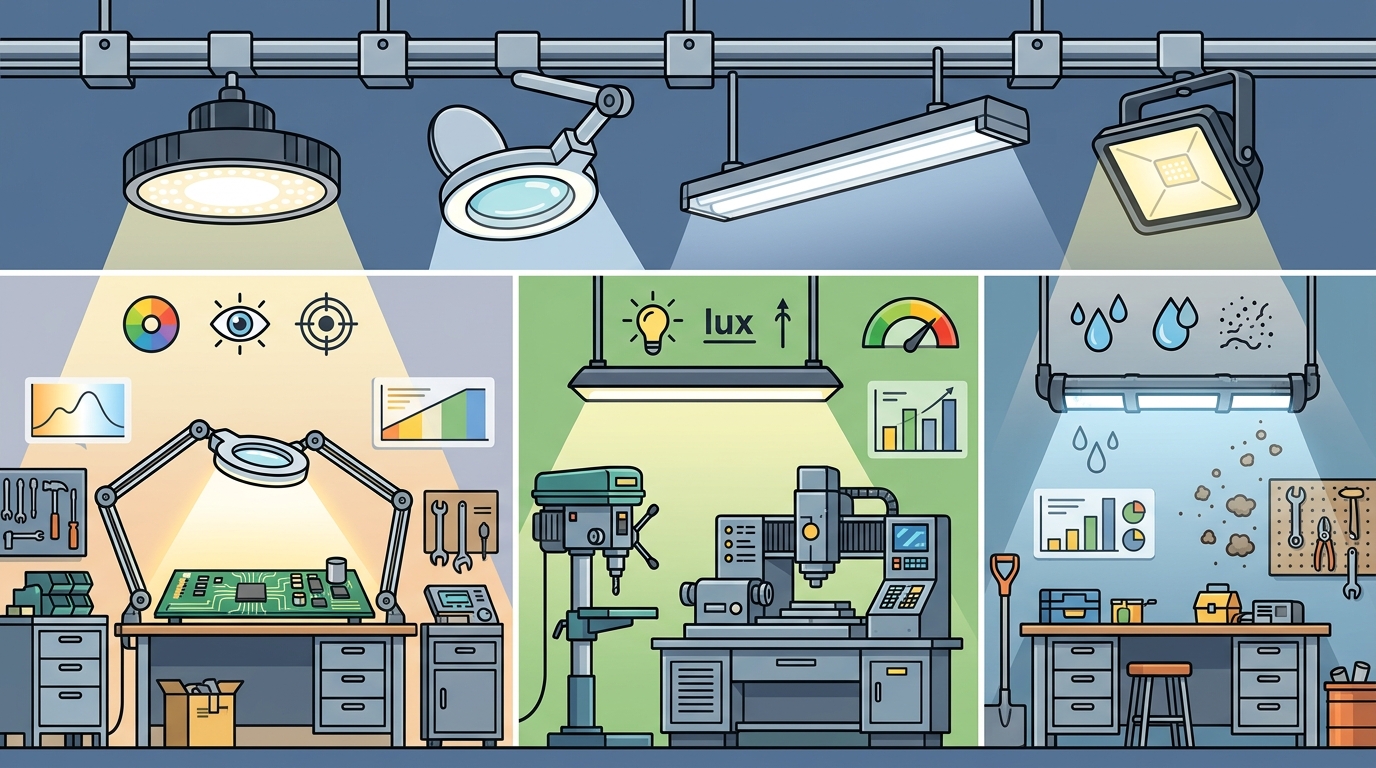
Ambient lighting provides general illumination for the entire room. Task lighting focuses light on a specific work area. A combination of both is ideal. For example, overhead panels provide ambient light, while articulated arm lamps provide focused task light for soldering or inspection.
Mounting Options
IP Protection in Workshops
Workshop environments can be harsh, with exposure to dust, oil, and water. Selecting fixtures with the appropriate IP rating ensures longevity and safety. The protection rating must match the specific conditions of the installation area.
Choosing the Right Rating
For dry areas, IP20 is standard. For areas with potential splashes, IP54 is recommended. For wet or wash-down areas, IP65 or higher is necessary. Always check the manufacturer's specifications to ensure the fixture is rated for your specific environment.
Key Takeaways
- Match illuminance levels to the specific task, ranging from 300 lux for general areas to 2000 lux for precision work.
- Select a Color Rendering Index (CRI) of 80 or higher for tasks involving color identification.
- Use 4000K color temperature as a standard for professional workshops to balance clarity and comfort.
- Choose IP ratings based on environmental hazards; IP54 is a common standard for industrial settings.
- Combine ambient and task lighting to reduce eye strain and improve accuracy.
- Consider LED efficiency (lm/W) to minimize long-term energy costs.
- Ensure fixtures are mounted securely and positioned to avoid shadows on the work surface.
Frequently Asked Questions
What is the difference between lumens and lux?
Lumens measure the total light output of a source. Lux measures the light intensity falling on a surface. One lux equals one lumen per square meter.
What CRI is recommended for electronics work?
A CRI of 80 or higher is recommended. For critical color matching, a CRI of 90 or higher is preferred to ensure accurate color perception.
Is 4000K or 5000K better for a workshop?
4000K is generally preferred for general workshop use as it is less fatiguing. 5000K can be used for specific high-detail tasks but may cause eye strain over long periods.
Do I need IP-rated lights for a dry workshop?
For a dry, clean workshop, IP20 is usually sufficient. However, if there is any risk of dust or splashes, IP54 is a safer choice for longevity.
How many lumens do I need for a 100 sqm workshop?
For general 300 lux illumination, you need approximately 30,000 lumens. For 500 lux, you need 50,000 lumens. This total should be distributed across multiple fixtures.