

Choosing the right workshop lighting requires balancing illuminance, color rendering, and environmental protection. PK Elektronik Vertriebs GmbH provides specialized lighting solutions for commercial users. This guide covers lux requirements, color temperature, CRI, IP ratings, and LED efficiency to help you optimize your workspace. For additional details, review the Kontaktieren Sie uns.
Lux and Lumens Requirements
Task-Specific Illuminance
General circulation lighting in a workshop should provide 200 to 300 lux. Task lighting, such as desk lamps or machine lights, should supplement this to reach the required level for the specific activity. High-precision work may require localized lighting that exceeds 1000 lux. Ensure that the lighting does not create excessive glare, which can reduce visual acuity and cause eye strain. For additional details, review the ESD Schutz L tstationen.
Color Temperature Selection
Color temperature is measured in Kelvin (K) and describes the hue of the light. Lower Kelvin values appear warmer, while higher values appear cooler. For workshop environments, a color temperature between 4000K and 5000K is generally recommended. This range provides a neutral white light that enhances visual clarity without causing excessive eye fatigue. Avoid very warm light (below 3000K) for detailed tasks, as it can distort color perception. Avoid very cool light (above 6000K) for general areas, as it may feel harsh and clinical. PK Elektronik Vertriebs GmbH stocks various LED task lights with selectable color temperatures to suit different workshop zones.
Impact on Visual Performance
Neutral white light (4000K) is often preferred for mixed-use workshops. It provides a balance between alertness and comfort. For areas where color differentiation is critical, such as quality control or painting, a consistent color temperature across all fixtures is essential to avoid visual confusion.
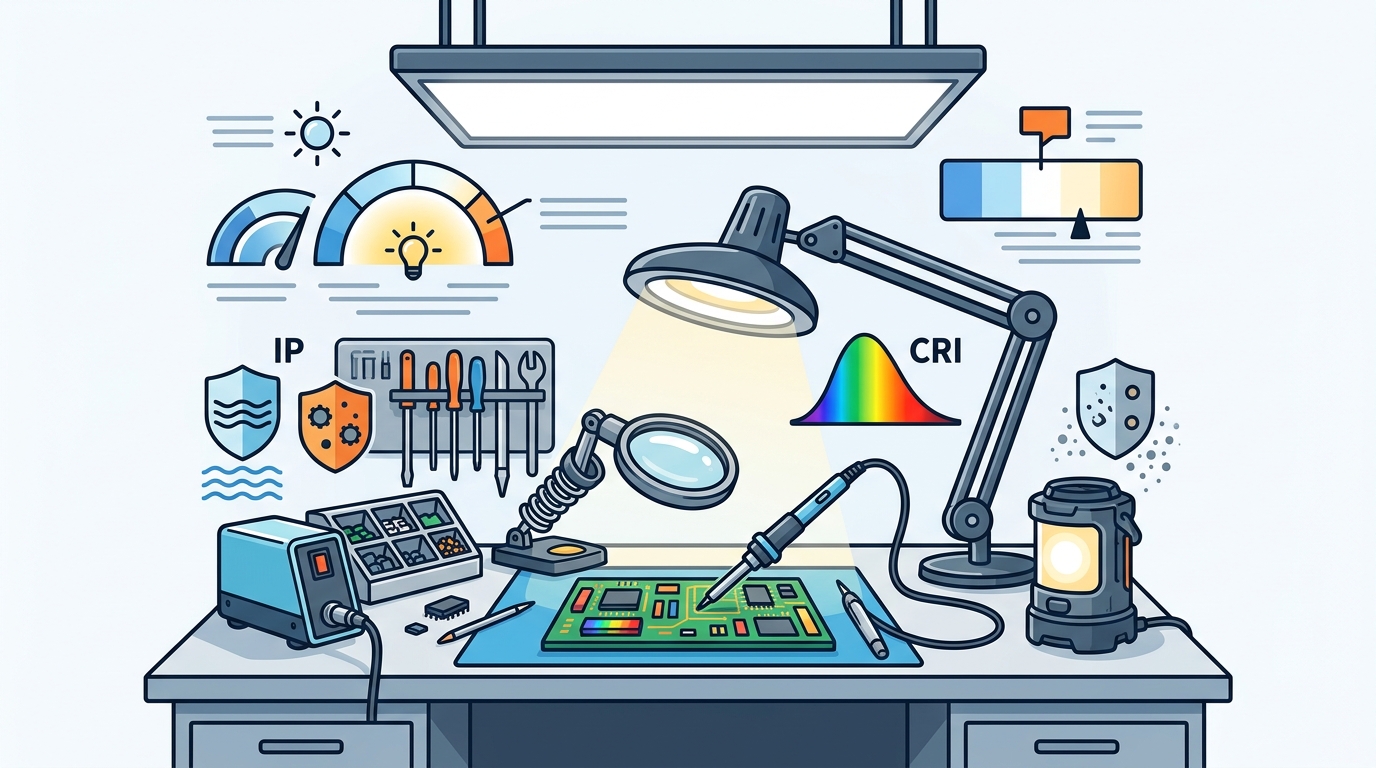
Color Rendering Index (CRI)
Color Rendering Index (CRI) is a measure of how accurately a light source reveals the true colors of objects compared to natural light. A CRI of 100 represents perfect color rendering. For workshop applications, a CRI of 80 or higher is the minimum standard. For tasks involving color matching, such as electronics assembly with colored components or quality inspection, a CRI of 90 or higher is recommended. Low CRI lighting can make it difficult to distinguish between similar colors, leading to errors. PK Elektronik Vertriebs GmbH provides high-CRI LED lamps that ensure accurate color perception for detailed work.
CRI and Task Accuracy
High CRI lighting reduces the cognitive load required to identify components. It allows technicians to quickly spot defects, discoloration, or misalignment. In ESD-sensitive areas, accurate color rendering is also important for verifying the integrity of ESD protective materials.
IP Ratings for Workshop Environments
Choosing the Right IP Rating
Assess the specific hazards in your workshop. If the area is prone to dust, choose a higher first digit. If the area is exposed to water or cleaning fluids, choose a higher second digit. Always refer to the manufacturer's documentation for the specific IP rating of a product. Do not assume that a product is suitable for a specific environment without verifying its IP rating.
LED Efficiency and Power Consumption
LED efficiency is measured in lumens per watt (lm/W). It indicates how effectively a light source converts electrical power into visible light. Modern LED fixtures typically achieve efficiencies between 80 and 150 lm/W. Higher efficiency means lower energy consumption for the same light output. This results in lower operating costs and reduced heat generation. Heat management is critical in workshop lighting, as excessive heat can affect the lifespan of the LED and the surrounding environment. PK Elektronik Vertriebs GmbH provides energy-efficient LED lighting that balances high efficiency with reliable thermal management.
Longevity and Maintenance
LEDs have a significantly longer lifespan than traditional lighting sources. They typically last between 30,000 and 50,000 hours. This reduces the frequency of maintenance and replacement. However, the actual lifespan can be affected by operating temperature and voltage fluctuations. Choose fixtures with robust thermal designs to maximize their service life.
Lighting Type Comparison
| Lighting Type | Typical Efficiency (lm/W) | Lifespan (Hours) | Best For |
|---|---|---|---|
| LED Task Light | 80-120 | 30,000-50,000 | Precision work, soldering |
| LED Panel | 100-150 | 30,000-50,000 | General workshop illumination |
| Fluorescent Tube | 60-100 | 10,000-20,000 | Legacy installations |
| Halogen | 10-20 | 2,000-4,000 | High CRI, low efficiency |
Key Takeaways
- Match lux levels to the specific task: 300-500 lux for general work, 750-1000 lux for precision tasks.
- Select a color temperature of 4000K to 5000K for neutral white light that enhances visual clarity.
- Choose a CRI of 80 or higher for general use, and 90 or higher for color-critical tasks.
- Verify the IP rating to ensure protection against dust and water in your specific workshop environment.
- Opt for high-efficiency LED fixtures (80-150 lm/W) to reduce energy costs and heat generation.
- Consider the total lumens required by multiplying the desired lux level by the area in square meters.
- Consult manufacturer documentation for specific product specifications and compatibility.
Frequently Asked Questions
What is the recommended lux level for a workshop?
For general workshop tasks, 300 to 500 lux is recommended. For precision tasks like soldering, 750 to 1000 lux is often required.
What color temperature is best for workshop lighting?
A color temperature of 4000K to 5000K is generally recommended for workshop environments. This provides a neutral white light that enhances visual clarity.
Why is CRI important in a workshop?
CRI is important because it determines how accurately a light source reveals the true colors of objects. A high CRI is essential for tasks involving color matching or quality inspection.
What IP rating should I choose for a dusty workshop?
For a dusty workshop, an IP54 or IP65 rating is recommended. IP54 provides protection against dust ingress and splashing water, while IP65 provides complete dust tightness.
How do I calculate the required lumens for my workshop?
Multiply the desired lux level by the area in square meters. For example, a 10 square meter area requiring 500 lux needs 5000 lumens.
Are LED lights more efficient than fluorescent lights?
Yes, LED lights are generally more efficient than fluorescent lights. Modern LED fixtures achieve efficiencies between 80 and 150 lm/W, while fluorescent tubes typically achieve 60 to 100 lm/W.