
ESD Protection Guide for Electronics: TVS Diodes and Workplace Controls
Electrostatic discharge (ESD) is a primary cause of electronic component failure. The most effective protection strategy combines component-level devices, such as TVS diodes, with rigorous workplace controls. PK Elektronik Vertriebs GmbH provides specialized equipment for businesses to implement these layers. This guide covers the technical specifications of transient voltage suppressors and the operational standards for ESD-safe workstations.
TVS Diodes for Component Protection
Transient Voltage Suppressor (TVS) diodes are semiconductor devices designed to protect sensitive circuits from voltage spikes. A TVS diode is a two-terminal device that clamps voltage to a safe level during transient events. These components are essential for protecting inputs, outputs, and power rails in electronic assemblies. For additional details, review the ESD Schutz L tstationen.
Understanding Clamping Voltage and Response Time
The performance of a TVS diode is defined by its clamping voltage and response time. The clamping voltage is the maximum voltage that appears across the diode during a specified transient current pulse. A lower clamping voltage provides better protection for downstream components. Response time is the duration it takes for the diode to switch from a high-impedance state to a low-impedance state. Modern TVS diodes typically respond in nanoseconds, which is critical for high-speed digital signals. For additional details, review the Erem.
Unidirectional vs. Bidirectional TVS Diodes
Unidirectional TVS diodes protect against positive transients in DC circuits. They are commonly used for power supply protection. Bidirectional TVS diodes protect against both positive and negative transients. These are suitable for AC circuits or data lines where the signal polarity can reverse. Selecting the correct type ensures that the protection device does not interfere with normal signal operation.
Integration into PCB Design
Proper placement of TVS diodes on a printed circuit board (PCB) is vital for effectiveness. The diode should be placed as close as possible to the point of entry for the transient energy. Short trace lengths between the diode and the protected component minimize inductance. This reduces the voltage spike seen by the sensitive device. Designers must also consider the power dissipation rating of the diode to ensure it can handle the expected energy levels without damage.
Workplace ESD Controls and Infrastructure
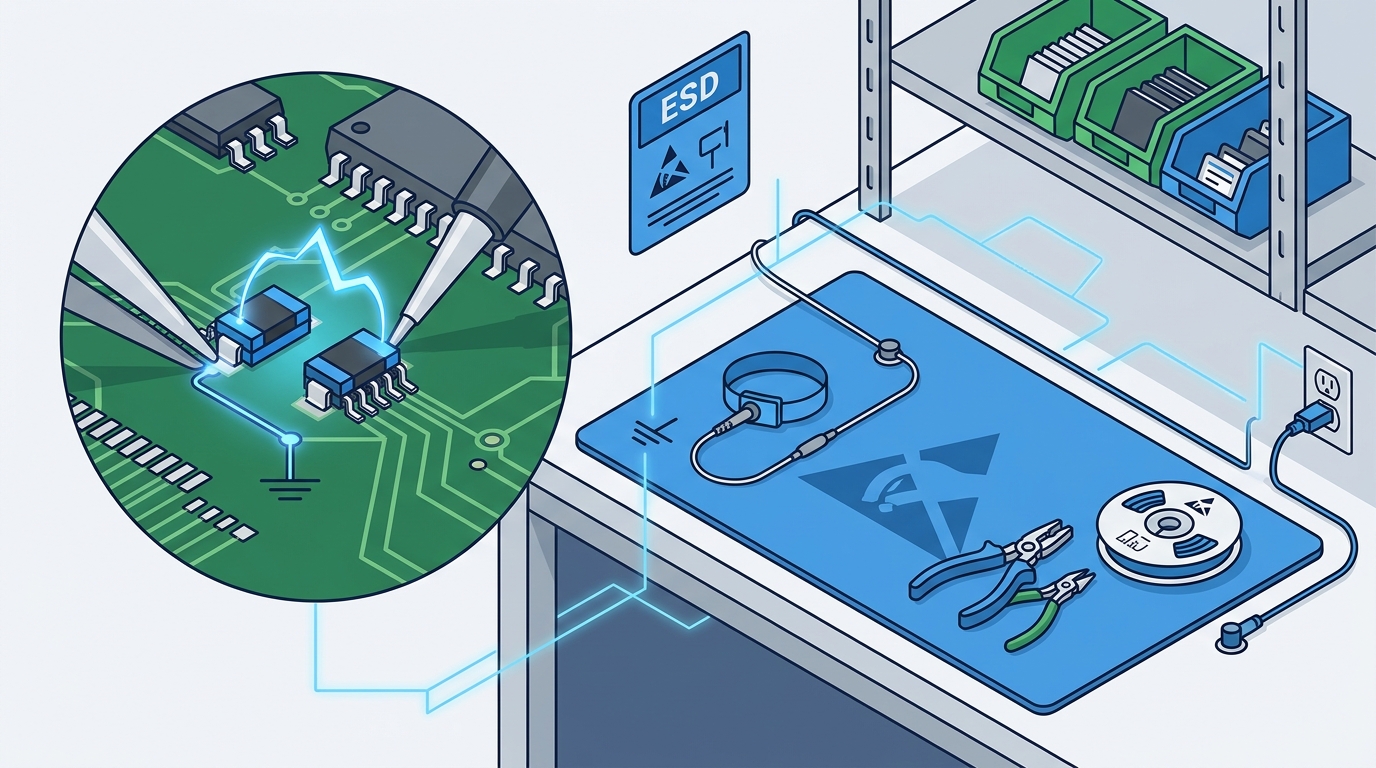
Component-level protection is insufficient without a controlled environment. Workplace ESD controls are a set of procedures and equipment designed to prevent the buildup and discharge of static electricity. These controls form an Electrostatic Protective Area (EPA). An EPA is a designated zone where ESD-sensitive devices are handled, stored, or processed.
Personal Grounding and Wrist Straps
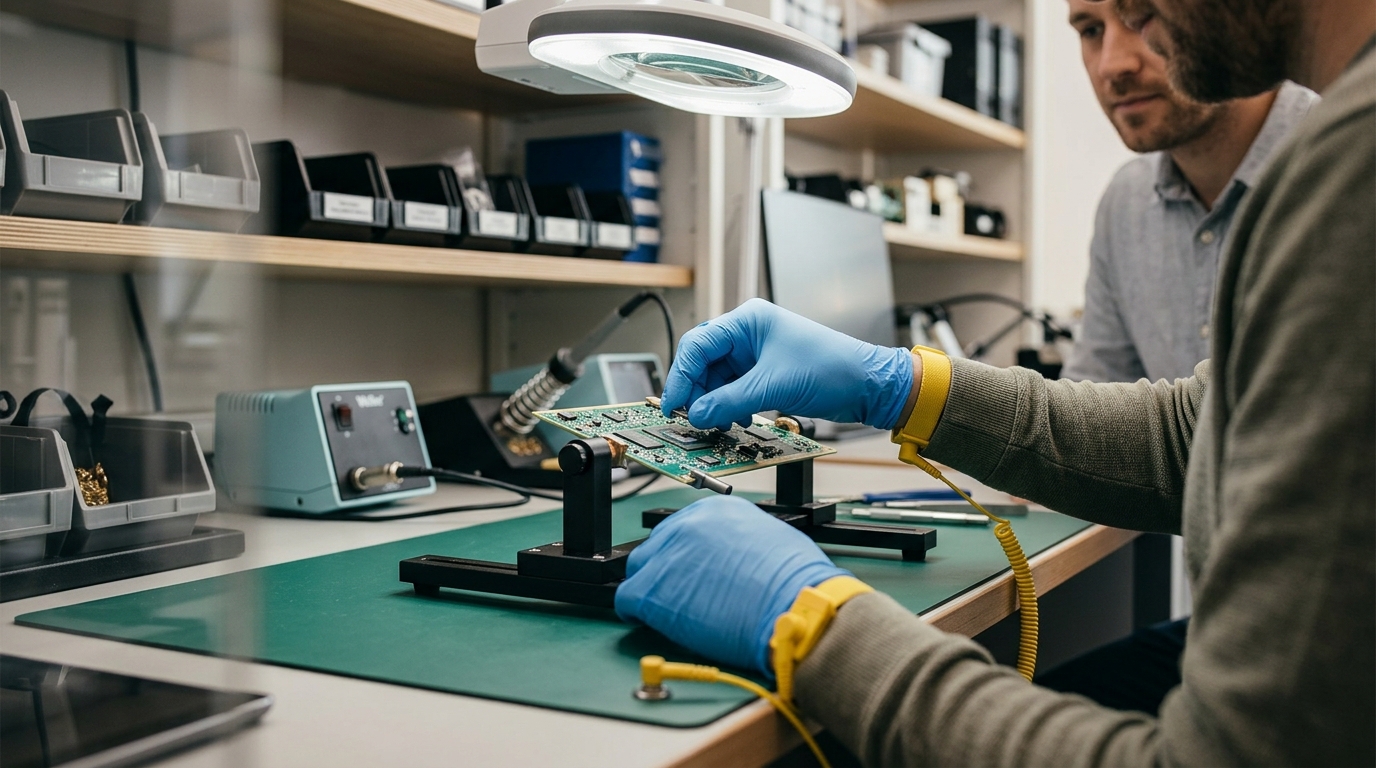
Personal grounding is the first line of defense in an EPA. A wrist strap is a conductive band worn on the wrist that connects the operator to the ground. It must be used in conjunction with a ground cord and a test point. Operators should verify the functionality of their wrist straps daily. This ensures that the resistance remains within the required range to safely dissipate static charges without posing a shock hazard.
Surface Materials and Flooring
Surface materials play a critical role in ESD control. ESD-safe workbench mats are used to provide a dissipative surface for components. These mats must be grounded to prevent charge accumulation. ESD flooring is often required in larger facilities to ground personnel and equipment. The resistance of these materials must be within specific limits to ensure that static charges dissipate quickly but not instantaneously. Instantaneous discharge can cause damage, while too high a resistance allows charge buildup.
Packaging and Handling
| Protection Layer | Primary Function | Key Components |
|---|---|---|
| Component Level | Clamping voltage spikes | TVS Diodes, Gas Discharge Tubes |
| Workstation Level | Dissipating static from surfaces | ESD Mats, Grounding Cords |
| Personnel Level | Grounding the operator | Wrist Straps, ESD Footwear |
| Facility Level | Controlling environmental charge | ESD Flooring, Ionizers |
Key Takeaways
- TVS diodes are essential for protecting electronic components from transient voltage spikes.
- The clamping voltage and response time are the critical specifications for TVS diode selection.
- Workplace ESD controls require a combination of personal grounding and surface materials.
- An Electrostatic Protective Area (EPA) must be established to handle sensitive devices safely.
- Daily verification of wrist straps and grounding points is a mandatory procedure.
- ESD-safe packaging prevents charge accumulation during storage and transport.
Frequently Asked Questions
What is the main difference between a TVS diode and a Zener diode?
A TVS diode is designed for transient protection with a fast response time and high power dissipation capability. A Zener diode is primarily used for voltage regulation in steady-state conditions. While both can clamp voltage, TVS diodes are optimized for short, high-energy pulses.
How often should ESD wrist straps be tested?
ESD wrist straps should be tested daily before use. This ensures that the strap and cord are functioning correctly and that the operator is properly grounded. Regular testing is a standard requirement in most ESD control programs.
Can ESD protection be achieved without grounding the workbench?
No, grounding the workbench is a fundamental requirement for ESD protection. Without a grounded dissipative surface, static charges can accumulate on components and tools, leading to potential discharge events.
What is the role of ionizers in ESD control?
Ionizers are used to neutralize static charges on non-conductive materials that cannot be grounded. They emit positive and negative ions that balance the charge on the surface. This is particularly useful for plastic housings or packaging materials.
Are ESD shoes sufficient for personal grounding?
ESD shoes are part of a personal grounding system but are not sufficient on their own. They must be used in conjunction with ESD flooring and heel or ankle grounders. The shoes provide a path to the floor, which must be grounded to complete the circuit.
Where can businesses purchase ESD protection equipment?
Conclusion
Effective ESD protection requires a multi-layered approach. Combining component-level devices like TVS diodes with comprehensive workplace controls ensures the safety of electronic assemblies. PK Elektronik Vertriebs GmbH provides the necessary equipment for businesses to establish and maintain ESD-safe environments. For specific product details and availability, please visit the ESD protection section of our online shop.