

Essential Standards and Quality Requirements for PCB Inspection Microscopes in German Electronics Manufacturing
Modern electronics manufacturing in Germany operates under some of the strictest quality control protocols in the world. According to recent industry reports, over 60% of production delays in SMT lines are caused by undetected micro-defects that only become visible under high-magnification inspection. This reality makes the choice of inspection equipment not just a technical decision, but a critical financial safeguard. For German manufacturers, compliance with DIN EN standards and ESD safety regulations is non-negotiable. This guide outlines the essential standards and quality requirements for selecting PCB inspection microscopes that meet these rigorous demands. (ESD Schutz L tstationen)
ESD Compliance and Safety Standards
In the context of sensitive electronics assembly, Electrostatic Discharge (ESD) is the silent killer of component reliability. German manufacturing facilities must adhere to DIN EN 61340-5-1, which sets the baseline for protecting electronic parts from static electricity. A PCB inspection microscope used in an Electrostatic Protected Area (EPA) must be fully ESD-safe. (Bandelin Ultraschallreinigungsger te)
This means every component of the microscope, from the eyepieces to the base, must be constructed from dissipative materials. The resistance to ground must typically fall between 10^6 and 10^9 ohms. PK Elektronik specializes in providing ESD-safe equipment that ensures your inspection process does not inadvertently damage the very boards you are trying to verify. Using non-compliant equipment can lead to latent defects that fail only after the product leaves your facility, causing costly recalls. (Bernstein)
Furthermore, the microscope must integrate seamlessly with your existing ESD flooring and grounding systems. This includes proper wrist strap connections and grounded power supplies. The integration of ionizers may also be necessary in high-humidity environments to neutralize charges on insulating surfaces like plastic microscope housings. (Bernstein ESD Handling Set)
Optical Specifications and Resolution
The core function of a PCB inspection microscope is to reveal defects invisible to the naked eye. The optical system must provide sharp, distortion-free images across the entire field of view. For surface mount technology (SMT) inspection, a magnification range of 7x to 45x is standard, while fine-pitch BGA (Ball Grid Array) inspection may require up to 100x or more.
Chromatic Aberration is a critical metric. Poor optics can cause color fringing around edges, making it difficult to distinguish between solder bridges and adjacent pads. High-quality trinocular heads with achromatic or plan-apochromatic lenses are preferred for color-critical tasks.
Resolution is determined by the numerical aperture (NA) of the objective lens. A higher NA allows for better light gathering and finer detail resolution. When inspecting high-density interconnect (HDI) boards, the clarity of the image directly impacts the speed and accuracy of the inspector. Blurry images lead to fatigue and increased error rates.
Additionally, the working distance between the objective lens and the PCB must be sufficient to accommodate thick components, such as capacitors or heatsinks, without collision. Adjustable working distance objectives provide the flexibility needed for diverse board types.
Illumination Requirements for Defect Detection
Lighting is as important as magnification in defect detection. The right illumination can highlight solder voids, cold joints, and component misalignment. German standards often require consistent, shadow-free lighting to ensure repeatable inspection results.
Coaxial Illumination is essential for inspecting reflective surfaces like solder pads and copper traces. It directs light straight down the optical axis, reducing glare and revealing surface topography. This is particularly useful for checking solder paste volume and alignment before reflow.
Ring Lights and Dual-Articulated Arms provide oblique lighting, which casts shadows that reveal height differences. This is crucial for detecting lifted leads, tombstoning, and component tilt. PK Elektronik offers a wide range of ESD-safe LED lighting solutions designed specifically for electronics workstations.
Color temperature is another key factor. A neutral white light (around 5000K to 6500K) is recommended to accurately assess solder color and component markings. Warm or cool lighting can distort colors, leading to misidentification of components or solder quality issues.
Measurement Accuracy and Calibration
Modern PCB inspection often goes beyond visual verification to include precise dimensional measurements. Inspectors need to measure pad widths, pitch distances, and solder joint heights. The microscope must support accurate measurement tools, either through integrated reticles or digital software.
Calibration is vital. The measurement system must be regularly calibrated against traceable standards to ensure accuracy. DIN EN ISO 10012 specifies the requirements for measurement management systems. Without proper calibration, measurements are meaningless and can lead to false passes or unnecessary rework.
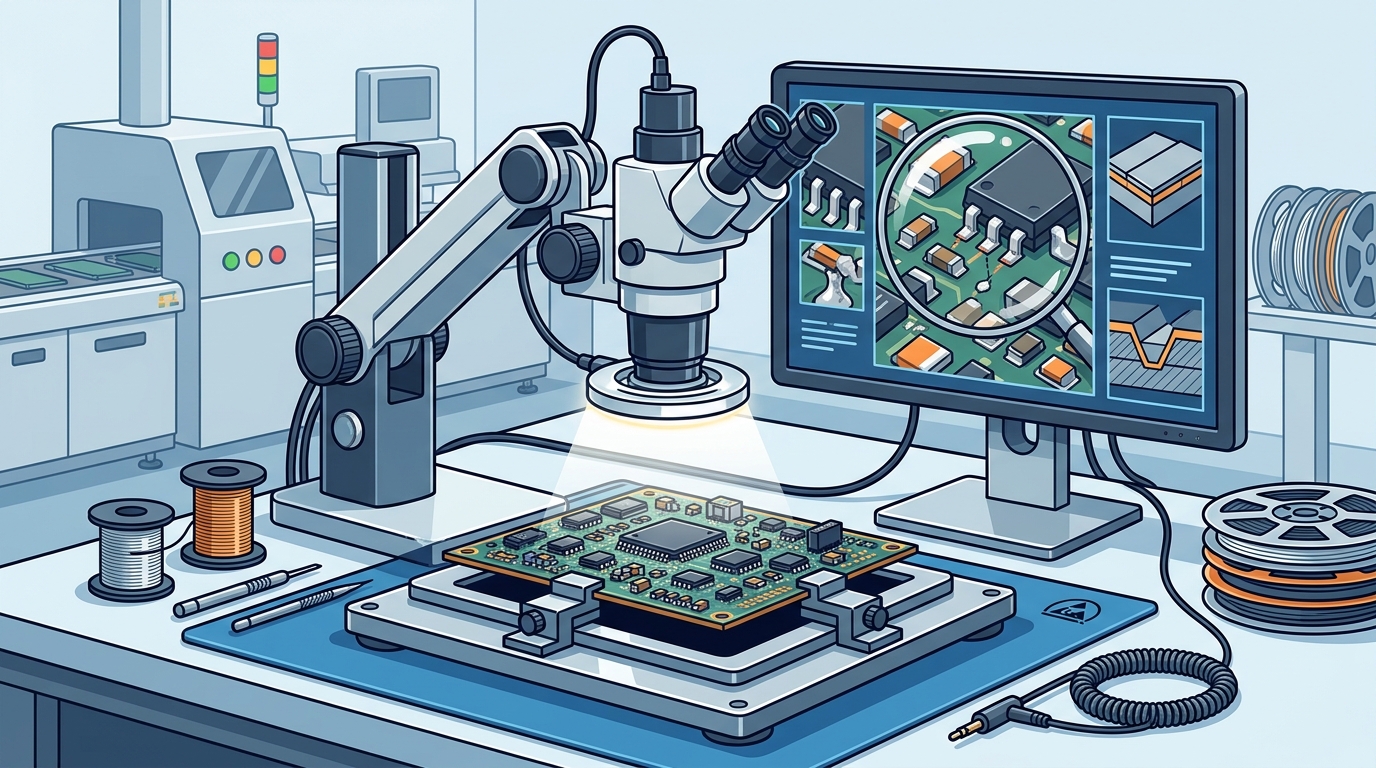
Digital microscopes with USB or HDMI outputs allow for image capture and analysis on a monitor. This facilitates documentation, team collaboration, and integration with automated optical inspection (AOI) systems. The ability to export high-resolution images is essential for quality reports and root cause analysis.
Ergonomics and Operator Health
Inspection is a repetitive task that can lead to musculoskeletal disorders if not ergonomically designed. German occupational health standards (DGUV regulations) emphasize the importance of workplace ergonomics. A poorly designed microscope setup can cause neck strain, back pain, and eye fatigue.
The microscope stand must be stable and adjustable in height and angle. A ergonomic ESD chair is equally important to support the operator during long shifts. The eyepieces should be interpupillary adjustable and diopter adjustable to accommodate different vision needs.
Headrests and chin rests can further reduce neck strain by supporting the head during prolonged use. The overall setup should allow the operator to maintain a neutral posture, with the screen or eyepieces at eye level. Investing in ergonomic equipment reduces absenteeism and improves long-term productivity.
Equipment Comparison Matrix
| Feature | Analog Stereo Microscope | Digital Trinocular Microscope | Integrated Inspection Station |
|---|---|---|---|
| Primary Use | General visual inspection | Documentation and measurement | High-volume QA/QC |
| ESD Safety | Requires specific dissipative models | Often built-in ESD components | Fully compliant EPA design |
| Illumination | Basic ring light | Adjustable coaxial and oblique | Multi-angle LED arrays |
| Integration | Standalone | PC software connection | AOI and MES systems |
| Cost | Low | Medium | High |
Key Takeaways
- ESD Compliance: All inspection equipment in an EPA must meet DIN EN 61340-5-1 standards to prevent static damage.
- Optical Quality: High-resolution, achromatic lenses are essential for detecting micro-defects in HDI boards.
- Illumination: Coaxial and oblique lighting combinations are necessary for comprehensive defect detection.
- Measurement: Regular calibration against traceable standards ensures data integrity and compliance.
- Ergonomics: Adjustable stands and ergonomic seating reduce operator fatigue and injury risk.
- Documentation: Digital microscopes facilitate image capture and integration with quality management systems.
- Vendor Expertise: Partnering with specialized suppliers like PK Elektronik ensures access to certified, high-quality equipment.
Frequently Asked Questions
What is the minimum order value for ESD equipment?
PK Elektronik enforces a minimum order value of 40 euros for all transactions to cover processing and shipping costs efficiently.
Can I buy inspection microscopes for personal use?
Since January 1, 2023, PK Elektronik sells exclusively to businesses, freelancers, and public institutions. Consumer sales are no longer permitted under § 13 BGB.
How do I ensure my microscope is ESD-safe?
Look for equipment explicitly labeled as ESD-safe, with resistive materials and grounding points. PK Elektronik provides ESD testing devices to verify compliance.
What is the difference between coaxial and oblique lighting?
Coaxial lighting shines light straight down the optical axis, ideal for reflective surfaces. Oblique lighting comes from the side, highlighting height differences and shadows.
Why is calibration important for inspection microscopes?
Calibration ensures that measurements taken through the microscope are accurate and traceable to international standards, which is critical for quality control.
Do you offer ergonomic chairs for inspection stations?
Yes, we provide a range of ESD-safe ergonomic chairs designed for long-term comfort in electronics workstations.
What brands of inspection equipment do you carry?
We carry top brands such as Bernstein for ESD handling and Bandelin for precision cleaning, ensuring high-quality standards.
Contact PK Elektronik for Expert Consultation
Ensuring the highest quality in your PCB inspection process requires the right equipment and expert guidance. PK Elektronik is your trusted partner for ESD-safe, high-precision inspection microscopes and related electronics manufacturing tools. Our team of specialists can help you select the perfect solution for your specific needs, from soldering stations to ultrasonic cleaners.
Visit our website to explore our full catalog of professional-grade equipment. For personalized advice, contact our support team at +49 (0) 7243 60595-0 or email info@pkelektronik.com. We are open Monday to Thursday until 17:00 and Friday until 15:00. Let us help you build a robust, compliant, and efficient inspection workflow.