
Common Workshop Lighting Mistakes and How to Avoid Them in Your Electronics Space
Proper illumination is not merely a comfort feature in an electronics workshop. It is a critical component of quality control and safety. According to industry standards for visual acuity, inadequate lighting can increase error rates by up to 30% during precision soldering tasks. This statistic highlights why professional environments prioritize high-fidelity light sources over standard ambient bulbs. Many technicians overlook the subtle impact of color temperature and shadow casting on their daily output. This guide details the most frequent lighting failures and provides concrete solutions to optimize your workspace. (ESD Schutz L tstationen)
The Critical Role of Color Accuracy
One of the most pervasive mistakes in electronics assembly is using standard white light bulbs with a low Color Rendering Index (CRI). Standard household bulbs often distort the true colors of components. This distortion makes it difficult to read resistor color bands accurately. It also obscures the subtle differences in solder joint quality. A dull or gray solder joint might appear shiny under poor lighting, leading to false confidence in the connection. (Bandelin Ultraschallreinigungsger te)
Color Rendering Index is a quantitative measure of the ability of a light source to reveal the colors of various objects faithfully in comparison with an ideal or natural light source. For electronics work, a CRI of 90 or higher is the industry baseline. PK Elektronik supplies specialized LED work lights designed specifically for this high-fidelity requirement. These lights ensure that the 5% tolerance of a resistor is visible without strain. (Bernstein)
Another common error is selecting the wrong color temperature. Cool white light, often found in office settings, can create a harsh glare that fatigues the eyes over long periods. Warm light, while cozy, lacks the contrast needed for detecting fine cracks in ceramic capacitors. The optimal range for electronics workshops is neutral to cool white, typically between 4000K and 5000K. This range mimics natural daylight, providing clear visibility without the blue-light intensity that causes rapid eye strain. (Bernstein ESD Handling Set)
Managing Shadows in Precision Work
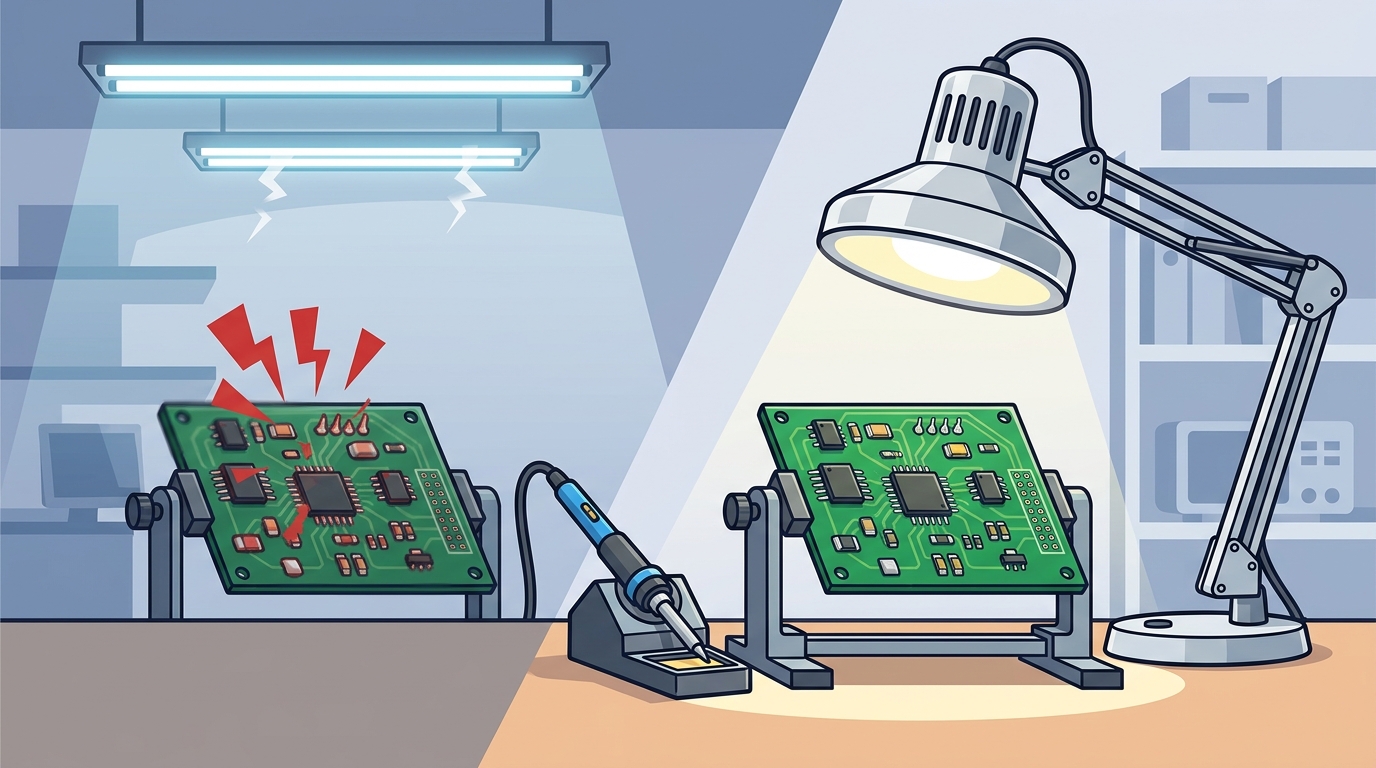
Shadows are the enemy of precision. When a technician's hand or head blocks the light source, critical details disappear into darkness. This is particularly dangerous when working with surface-mount devices (SMD) or fine-pitch integrated circuits. A single missed solder bridge can cause a circuit failure that is difficult to diagnose later. Many workshops rely on a single overhead light, which creates deep, unmanageable shadows directly under the work area.
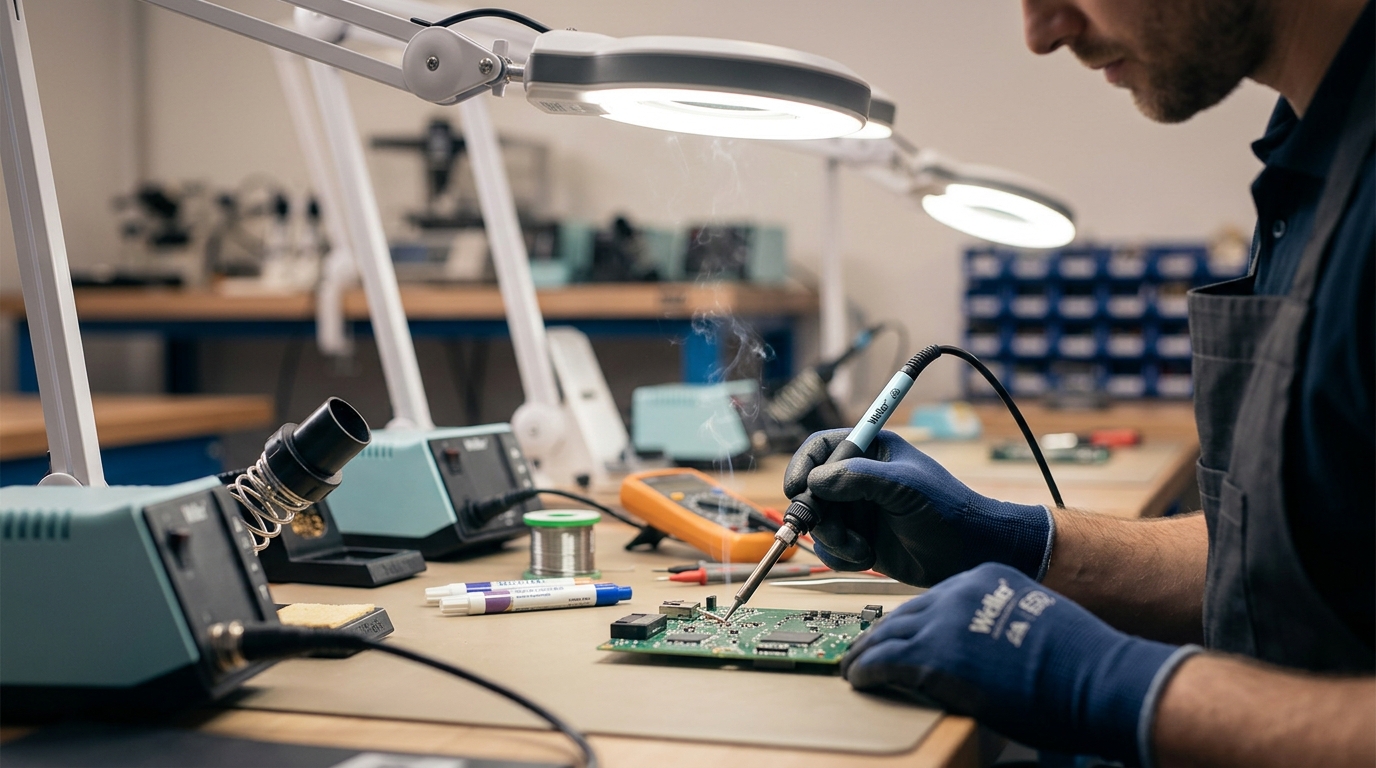
The solution is directional, adjustable task lighting. LED desk lamps with articulated arms allow you to position the light source at a 45-degree angle to the work surface. This angle minimizes shadow formation while maximizing surface reflection. PK Elektronik offers a range of Arbeitsleuchten designed to provide focused, shadow-free illumination. These lights often feature adjustable brightness controls to adapt to different component sizes.
For even greater precision, consider using a magnifying lamp with integrated lighting. These devices combine optical magnification with high-intensity LED arrays. The light is positioned directly at the focal point of the lens. This setup ensures that the area under inspection is always brightly lit, regardless of the ambient room conditions. It is an essential tool for inspecting Lupenleuchten quality and performance in a professional setting.
ESD-Safe Lighting Infrastructure
Electrostatic Discharge (ESD) is a silent killer in electronics manufacturing. One of the most overlooked mistakes is installing standard plastic or non-conductive lighting fixtures in an ESD-protected area (EPA). These materials can generate static charges through friction or air movement. When a technician reaches for a standard lamp, they may inadvertently introduce a static charge into the workspace. This charge can damage sensitive components before they are even installed.
ESD-safe lighting must be constructed from materials that dissipate static charge safely to ground. This includes ESD-safe plastic housings and conductive mounting hardware. PK Elektronik specializes in ESD-Systemleuchten that meet strict industrial standards. These lights are designed to prevent the accumulation of static electricity while providing the necessary illumination for sensitive work. Using non-compliant lighting in an EPA voids the safety integrity of the entire workspace.
Additionally, the mounting method matters. ESD-safe lights should be connected to the facility's grounding system. This ensures that any incidental charge is immediately dissipated. Regular testing of the grounding continuity is required to maintain compliance. PK Elektronik provides ESD-Messgeräte to verify the integrity of your grounding infrastructure. This includes testing the resistance of the light fixtures themselves.
Heat Management in LED Systems
While LED technology has revolutionized workshop lighting, improper heat management can still lead to premature failure. LEDs generate heat at the base of the diode. If this heat is not dissipated effectively, the light output degrades rapidly. The color temperature may shift, and the lifespan of the bulb can drop from 50,000 hours to just a few thousand. This is a common mistake when selecting low-cost, unbranded LED fixtures.
High-quality LED work lights use aluminum heat sinks to draw heat away from the diodes. These heat sinks are often finned to increase surface area and improve airflow. When evaluating a light fixture, check the construction of the base. A solid aluminum housing is a strong indicator of good thermal design. PK Elektronik sources LED-Tischleuchten from reputable manufacturers who prioritize thermal engineering. This ensures consistent performance over years of daily use.
Another factor is the placement of the light source. If a light is enclosed in a tight fixture without ventilation, heat will build up. This is particularly relevant for Pendelleuchten installed over sensitive equipment. Ensure that there is adequate clearance around the light source to allow for natural convection cooling. This simple step can significantly extend the life of your lighting investment.
Cleaning and Maintenance Protocols
Even the best lighting system will fail if it is not maintained. Dust and grime accumulate on light fixtures over time. This accumulation reduces the light output by up to 20% in just a few months. It also creates hot spots where the light is unevenly distributed. Many technicians ignore this gradual decline until the light is clearly insufficient. By then, the quality of their work may have already been compromised.
Regular cleaning is essential. Use a soft, dry cloth to wipe down the lenses and reflectors. For stubborn grime, use a mild detergent solution. Avoid abrasive cleaners that can scratch the lens surface. Scratches scatter light and reduce clarity. PK Elektronik recommends a monthly cleaning schedule for all workshop lights. This simple habit ensures that your workspace remains optimized for precision.
Inspect the wiring and connections regularly. Vibration from tools and equipment can loosen connections over time. A loose connection can cause flickering, which is a major distraction during delicate work. If you notice any flickering, turn off the light immediately and check the connections. PK Elektronik offers Elektronikreiniger that can be used to clean contacts without leaving residue. This ensures reliable electrical performance.
Key Takeaways
- Inadequate lighting can increase error rates by up to 30% during precision soldering tasks.
- Color Rendering Index is a quantitative measure of the ability of a light source to reveal the colors of various objects faithfully.
- ESD-safe lighting must be constructed from materials that dissipate static charge safely to ground.
- High-quality LED work lights use aluminum heat sinks to draw heat away from the diodes.
- Dust and grime accumulation can reduce light output by up to 20% in just a few months.
- PK Elektronik sells exclusively to businesses and public institutions since January 1, 2023.
- A minimum order value of 40,- € applies to all transactions.
Frequently Asked Questions
What is the minimum order value at PK Elektronik?
The minimum order value is 40,- € (gross merchandise value excluding shipping costs after any discounts).
Does PK Elektronik sell to private consumers?
No, since January 1, 2023, PK Elektronik sells exclusively to entrepreneurs, self-employed professionals, and public institutions.
What is the optimal color temperature for electronics work?
The optimal range is typically between 4000K and 5000K, which mimics natural daylight and provides clear visibility.
Why is ESD-safe lighting important?
ESD-safe lighting prevents the accumulation of static electricity, which can damage sensitive electronic components.
How often should workshop lights be cleaned?
Monthly cleaning is recommended to prevent dust accumulation from reducing light output and clarity.
What is the Color Rendering Index (CRI)?
Color Rendering Index is a quantitative measure of the ability of a light source to reveal the colors of various objects faithfully.
Do PK Elektronik lights come with grounding options?
Yes, many of their ESD-safe lights are designed to be connected to the facility's grounding system for safety.
Optimize Your Workspace Today
Investing in the right lighting is an investment in the quality and safety of your electronics work. By avoiding these common mistakes, you can significantly improve your precision and reduce errors. PK Elektronik offers a comprehensive range of professional lighting solutions tailored for electronics workshops. Explore our Beleuchtung catalog to find the perfect fit for your needs. Contact us at +49 (0) 7243 60595-0 or visit our contact page for expert advice.