
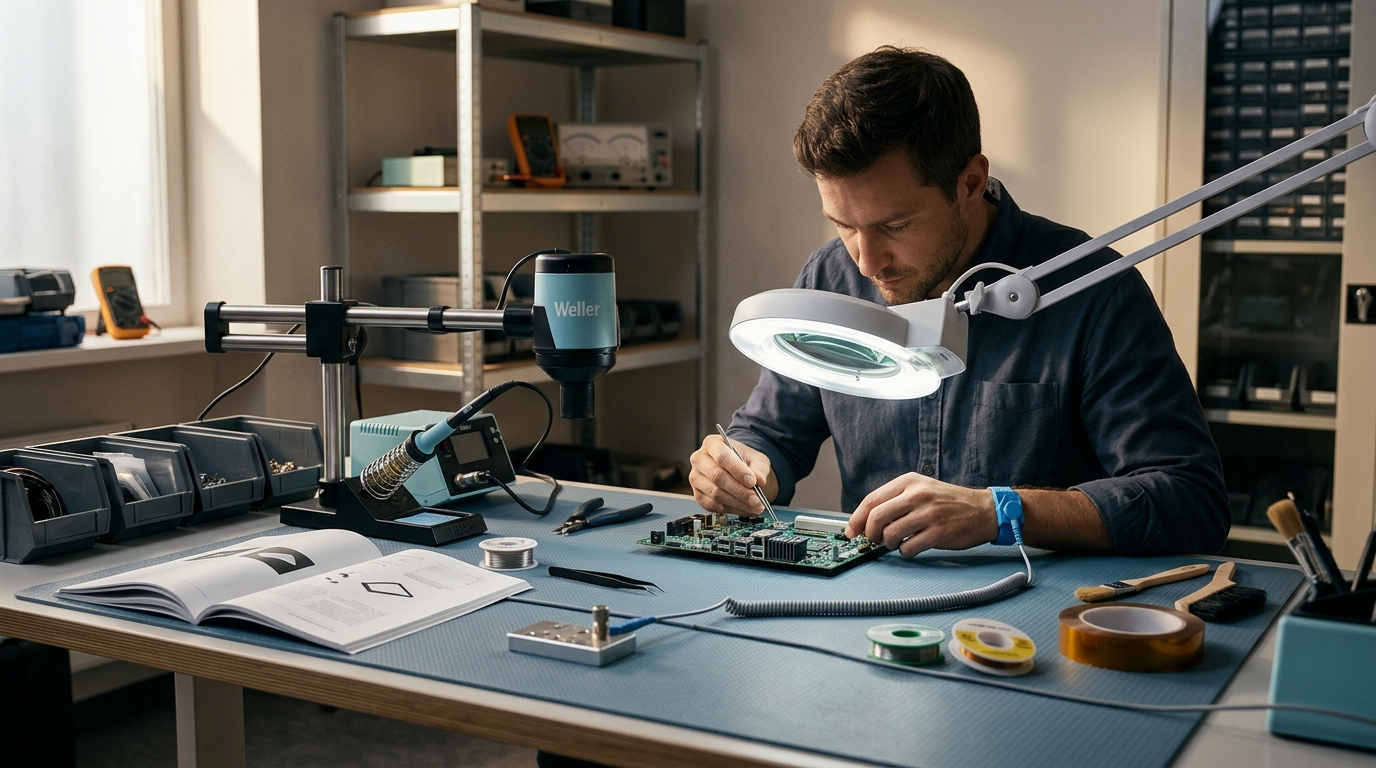
Establishing a professional-grade electronics workshop requires more than just a workbench and a soldering iron. It demands a rigorous adherence to Electrostatic Discharge (ESD) safety standards to protect sensitive components from invisible damage. According to industry data, over 70% of electronic component failures are attributed to ESD events that are not immediately visible to the human eye. This statistic highlights why a controlled environment is not optional but essential for any serious technician or engineer. The following guide outlines the critical infrastructure, from grounding systems to precision lighting, necessary to create a high-performance workspace. (ESD Schutz L tstationen)
ESD Infrastructure and Grounding
The foundation of any safe electronics workshop is the Electrostatic Discharge (ESD) protection system. ESD is the sudden flow of electricity between two electrically charged objects caused by contact, a short circuit, or dielectric breakdown. In a workshop context, this discharge can destroy microchips and delicate sensors before they are even installed. (Bandelin Ultraschallreinigungsger te)
ESD is the sudden flow of electricity between two electrically charged objects. To mitigate this risk, you must implement a comprehensive ESD protection area (EPA). This begins with the floor and extends to every surface and tool within the workspace. (Bernstein)
Grounding Systems and Mats
Your primary defense is a high-quality ESD mat connected to a common grounding point. These mats dissipate static charge safely to the ground, preventing buildup on your workbench. You should pair these with ESD wrist straps that provide continuous monitoring of your grounding connection. For larger work areas, consider installing ESD system lighting that integrates grounding into the fixture itself, ensuring consistent safety across the entire room. (Bernstein ESD Handling Set)
Additionally, ESD flooring or conductive mats are crucial for preventing charge accumulation from foot traffic. Without proper grounding, your body can act as a capacitor, discharging thousands of volts onto a circuit board. Resources from the ESD Association provide detailed standards for designing these protection zones effectively.
Ionization for Non-Conductive Materials
While conductive materials can be grounded, non-conductive materials like standard plastic tools or certain circuit board substrates cannot. This is where ionizers become critical. Ionizers neutralize static charges on insulating materials by emitting positive and negative ions into the air. According to technical reports on semiconductor manufacturing, ionization is the only effective method for reducing static on non-conductive surfaces. You should place ionizing blowers near your work area to neutralize charges on components as they are handled.
Workstation Ergonomics and Storage
A functional workshop must balance safety with ergonomic efficiency. Long hours of precise soldering and inspection require furniture that supports posture and organization.
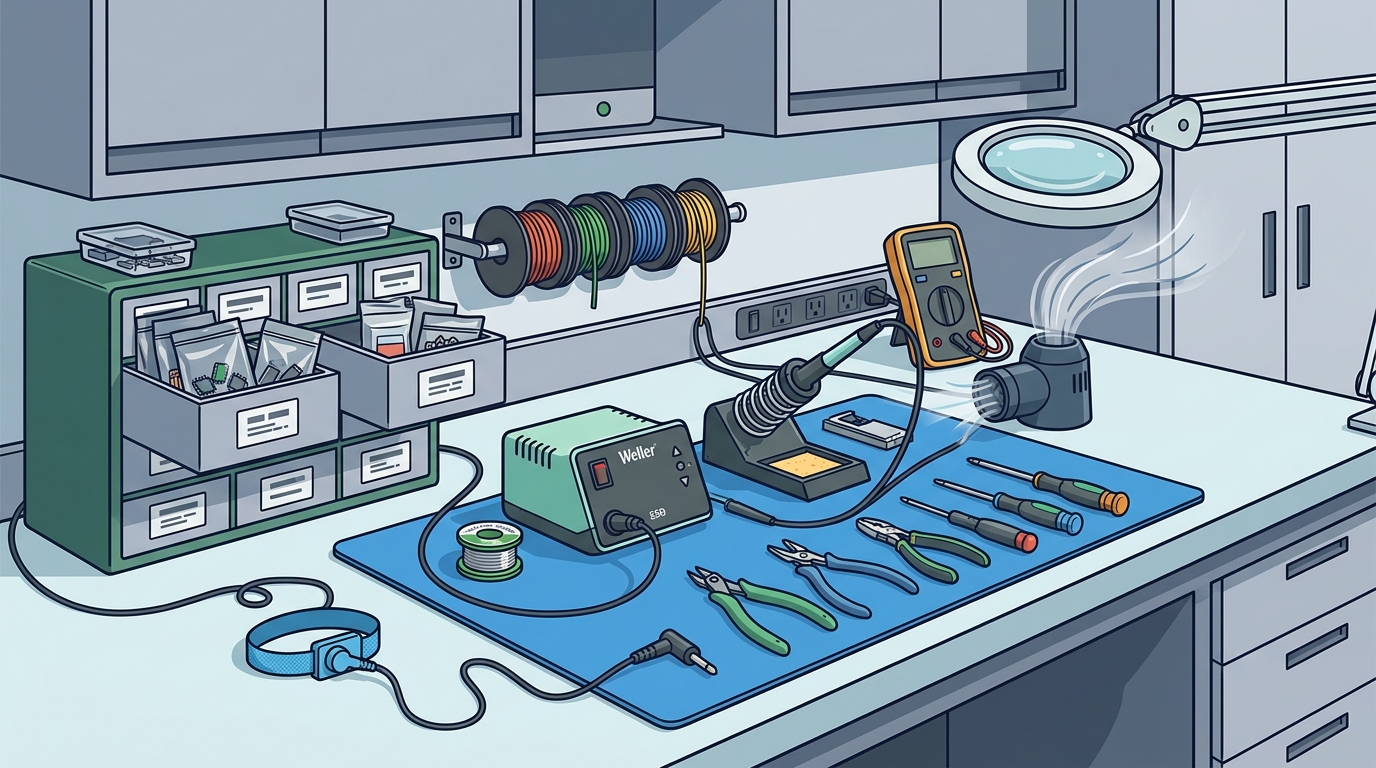
ESD-Safe Furniture
Standard office chairs can generate significant static electricity through friction. You must use ESD-safe chairs that are constructed with conductive materials to prevent charge buildup. These chairs often feature permanent grounding connectors that link to your workspace ground. Look for models with adjustable height and tilt to accommodate different user heights during detailed work.
Workbenches should be made of or coated with ESD-safe materials. Many professional setups use specialized ESD workbenches that include integrated grounding points for tools and equipment. Proper storage is equally important. Use ESD-safe shelving and cabinets to store sensitive components. Standard plastic bins can generate static charges that damage stored parts. Instead, opt for ESD drawer systems that provide both protection and organization for small components like resistors, capacitors, and ICs.
Component Organization
Efficiency in the workshop depends on quick access to parts. Use anti-static trays and reels for surface-mount devices (SMD). Keep frequently used tools within arm's reach to minimize movement and potential static generation. A well-organized bench reduces the time spent searching for parts, which in turn reduces the risk of accidental ESD events due to rushed handling.
Precision Soldering and Desoldering
The core activity in any electronics workshop is soldering. Whether you are assembling a PCB or repairing a complex device, the quality of your solder joints determines the reliability of your work.
Choosing the Right Soldering Station
Invest in a high-quality temperature-controlled soldering station. Cheap irons often fluctuate in temperature, leading to cold solder joints or damage to heat-sensitive components. Look for stations with fast heat-up times and precise temperature feedback. For SMD work, a hot air rework station is indispensable. These tools allow you to remove and replace surface-mount components with precision.
When selecting solder wire, consider the alloy composition. Lead-free solder, such as Sn-3.0Ag0.5Cu, is the industry standard for environmental compliance. However, it requires higher temperatures and different flux characteristics than traditional leaded solder. Ensure your soldering stations can handle the thermal demands of lead-free alloys without degrading tips prematurely.
Desoldering Techniques
Desoldering is just as critical as soldering. Use a reliable desoldering pump or a desoldering iron with a vacuum system. For fine-pitch components, desoldering wick is essential. It absorbs excess solder, allowing you to clean up joints without damaging the pads. Always use flux to ensure smooth solder flow and easy removal. According to engineering best practices, proper flux usage can reduce solder joint defects by up to 50%.
Heat Management
Excessive heat is a common cause of PCB damage. Use heat sinks on component leads during soldering to draw heat away from the component. For sensitive ICs, consider using a preheater to reduce the thermal gradient between the board and the component. This minimizes the stress on the board during soldering. Proper heat management extends the life of your components and ensures a reliable connection.
Cleaning and Maintenance Protocols
Maintaining a clean workspace is vital for both safety and component longevity. Flux residue and dust can cause short circuits or corrosion over time.
Flux Removal
After soldering, remove flux residue using an appropriate cleaner. Isopropyl alcohol (IPA) is a common choice for general cleaning. However, for more stubborn residues or sensitive applications, specialized electronics cleaners are recommended. These cleaners evaporate quickly and leave no residue, ensuring that your boards remain electrically clean.
Ultrasonic Cleaning
For complex assemblies or heavily soiled components, ultrasonic cleaning is the gold standard. Ultrasonic cleaners use high-frequency sound waves to create cavitation bubbles in a cleaning solution. These bubbles implode on the surface of the components, dislodging dirt and flux from hard-to-reach areas. A Bandelin ultrasonic cleaner is a popular choice for professional workshops due to its consistent performance and durability.
Tool Maintenance
Regular maintenance of your tools is essential. Clean soldering iron tips with a damp sponge or brass wool after each use. Inspect desoldering pumps for clogs and replace filters as needed. Keep your multimeter probes clean and calibrated. According to testing standards, regular calibration of measurement tools ensures accuracy within specified tolerances, which is critical for troubleshooting.
Lighting and Visibility Solutions
Proper lighting is often overlooked but is crucial for precision work. Poor lighting leads to eye strain and increases the risk of errors.
Task Lighting
Use focused task lighting to illuminate your work area. LED work lights provide bright, shadow-free illumination. Look for lights with adjustable arms and clamps to position the light exactly where you need it. Color temperature matters; choose lights with a high Color Rendering Index (CRI) to accurately see component colors and markings.
ESD-Safe Lighting
In an ESD-protected area, standard lighting fixtures may generate static charge. Use ESD system lighting that is designed to dissipate static charge. These fixtures are grounded and prevent the buildup of static electricity on the light housing itself. This ensures that your lighting solution does not compromise the safety of your workspace.
Magnification
For fine-pitch components, magnification is necessary. A quality magnifying lamp or a digital microscope can reveal solder bridges and cold joints that are invisible to the naked eye. Ensure that your magnification tool is ESD-safe if it is used within the protected area. Some ESD magnifying lamps combine lighting and magnification in a grounded unit, providing a comprehensive solution for detailed inspection.
Key Takeaways
- ESD Protection is Mandatory: Implement a full EPA with grounding mats, wrist straps, and ionizers to prevent invisible component damage.
- Grounding is Critical: All conductive surfaces, including chairs and workbenches, must be connected to a common ground point.
- Precision Tools Matter: Invest in temperature-controlled soldering stations and hot air rework tools for reliable joints.
- Cleaning is Essential: Use ultrasonic cleaners and specialized electronics cleaners to remove flux and prevent corrosion.
- Lighting Impacts Quality: Use high-CRI LED task lighting and ESD-safe fixtures to ensure visibility without compromising safety.
- Organization Reduces Risk: Store components in ESD-safe drawers and trays to maintain their integrity.
- Maintenance Ensures Accuracy: Regularly calibrate multimeters and clean tool tips to maintain high standards of work.
Frequently Asked Questions
What is the minimum requirement for an ESD-safe workspace?
An ESD-safe workspace requires a grounded conductive mat, a wrist strap connected to the same ground, and ionizers for non-conductive materials. This setup prevents static buildup on both the user and the components.
How often should I replace my soldering iron tip?
Tip replacement depends on usage and maintenance. However, if the tip shows significant pitting, erosion, or fails to tin properly despite cleaning, it should be replaced. Regular cleaning with brass wool can extend tip life.
Can I use standard plastic bins for storing electronic components?
No. Standard plastic bins generate static charge that can damage sensitive components. You must use ESD-safe storage containers, which are typically made from conductive or dissipative materials.
What is the difference between leaded and lead-free solder?
Leaded solder melts at a lower temperature and flows more easily, making it ideal for hobbyists. Lead-free solder, such as Sn-Ag-Cu, is required for environmental compliance in professional manufacturing but requires higher temperatures.
Why is ionization necessary in an ESD workspace?
Ionization is necessary to neutralize static charges on non-conductive materials, such as plastic tools or circuit board substrates, which cannot be grounded. Without ionization, these materials can still discharge static electricity onto components.
How do I choose the right magnification for my work?
Choose magnification based on the size of the components you work with. For SMD components, a magnifying lamp with 2x to 5x magnification is usually sufficient. For very fine-pitch ICs, a digital microscope with higher magnification is recommended.
What is the role of flux in soldering?
Flux cleans the metal surfaces by removing oxidation and promotes the flow of solder. It ensures a strong, reliable electrical and mechanical bond between the solder and the component leads.
Start Your Workshop Setup
Building a professional electronics workshop is an investment in quality and reliability. By prioritizing ESD safety, precision tools, and proper organization, you can ensure that your work meets the highest industry standards. PK Elektronik offers a comprehensive range of ESD protection, soldering equipment, and workshop accessories to help you build the perfect workspace. Explore our catalog to find the right tools for your needs.
Visit PK Elektronik to browse our full selection of professional electronics workshop supplies.